Contact Us
Location :
44 Jason Ct, St Charles, MO 63304

Appearance:
Behaviors:
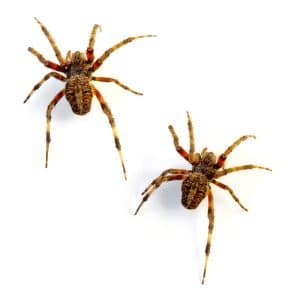 Two of the most common and easily recognizable species among these are the Yellow Garden Spider and the slightly smaller Banded Garden Spider, both of which are named for their strong preference for building their webs in gardens. These garden spiders are sometimes called “writing spiders” due to a unique zigzag pattern that they weave into their webs, called a stabilimentum, but none have ever been observed writing actual words (Sorry, Charlotte’s Web fans).
Appearance:
Behavior:
 Appearance:
Behaviors:
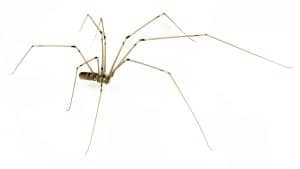 So what’s everyone getting wrong about these supposedly harmless spiders? Well, for starters, Daddy Long-legs are not spiders- they do not have the necessary fangs, venom glands, or silk-producing spinnerets, meaning that they cannot bite or create webs. For that reason, Daddy Long-legs, or Harvestmen, are classified as their own order of arachnids called Opiliones. As they don’t possess the necessary physiology to hunt for prey like spiders do, Harvestmen are largely scavenging omnivores, with a diet consisting of plants & fungus, small insects like aphids, and various dead organisms.
Harvestmen, while somewhat creepy, are harmless, and should not be conflated with spiders. Below are a few telltale behaviors and characteristics of Harvestmen to aid in their identification.
Appearance:
Behavior:
Moisture-loving: Harvestmen do not retain moisture well, and as such, can dry out and die rather easily. This is why they prefer to live in shaded, moist places like basements and crawl spaces, as well as under the bark of trees and in piles of leaf litter.
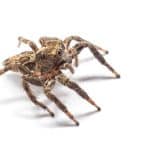
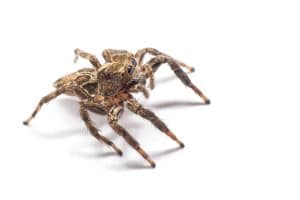 As their name suggests, jumping spiders can jump- remarkably well, in fact. These spiders are capable of jumping distances dozens of times longer than their own body length, all thanks to a handy trick they can do with the blood pressure in their hind legs. Jumping spiders use this trick to get around their environment, as well as to pounce on their prey from afar.
Now, if you’re a football fan, you’ll know that executing a leaping tackle on a moving target can be quite a task, even for professional athletes. So how is it that a spider with a brain the size of a poppy seed can do it with ease? Well… no one knows! Extensive research has shown that jumping spiders have exceptional vision, which allows them to locate their prey and ascertain its distance, but researchers have yet to discern how these spiders manage to employ such dynamic thought processes (calculating trajectory, threat assessment, indirect stalking approach, etc.) with so little available brain matter.
Through their masterful pest hunting practices and human-avoidant lifestyles, jumping spiders have earned the approval, and even affection, of many people. There’s even a growing number of people who keep jumping spiders as pets! This is likely due to jumping spiders’ large, almost expressive eyes, which give them a ‘cuter’ appearance than most spiders. Below is a list of some more physical characteristics of jumping spiders, as well as some of their common behaviors.
Appearance:
Behavior:
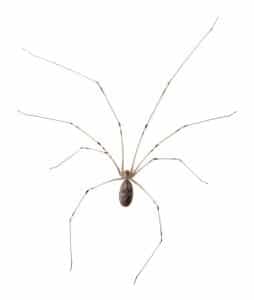 Despite their small and wispy appearance, these spiders are highly effective hunters, and have a propensity to prey upon both insects and fellow spiders alike. Unlike most spiders, Cellar spiders are largely found indoors, as they have adapted specifically to benefit from the conditions inside human dwellings. Some species cannot effectively survive outdoors, and will quickly die if ‘taken outside’.
There are over 1600 species of cellar spider, all of which sporting distinct appearances and behaviors. Below you can find a short list of their common appearances and characteristics.
Appearance:
Behavior:
Spider Hunters: Cellar spiders commonly prey upon other spiders, such as house spiders, funnel-web spiders, and even some species of widow spiders.
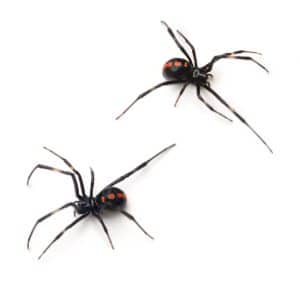 As with many species, male black widows are much smaller than their female counterparts, and as their venom glands are also much smaller, are not dangerous to humans. Female black widows, on the other hand, have very large venom glands, and thus, are dangerous to humans. Bites from female black widows can cause excruciating pain, sweating, vomiting, and muscle stiffness. These symptoms normally last three to six days, but can persist for weeks or months in extreme cases. While there hasn’t been a recorded death from a black widow bite since 1983, life threatening symptoms can occur in very rare cases. If you think you or your pet have been bitten by a black widow, the best course of action is to seek medical attention as soon as possible.
Black widows prefer the outdoors, typically opting to build their webs in semi-sheltered places near ground level, such as wood piles and shrubs. When found in the home, black widows usually reside in dark, less active spaces like garages, crawlspaces, and basements. These spiders will not typically inhabit a residence unless there is an available food source (existing insect population) for them to subsist on.
Appearance
Behavior:
 Call Now